Transaction Monitoring: Turning Payment Data Into Actionable Risk Signals

Business Head
Overview: What Is Transaction Monitoring?
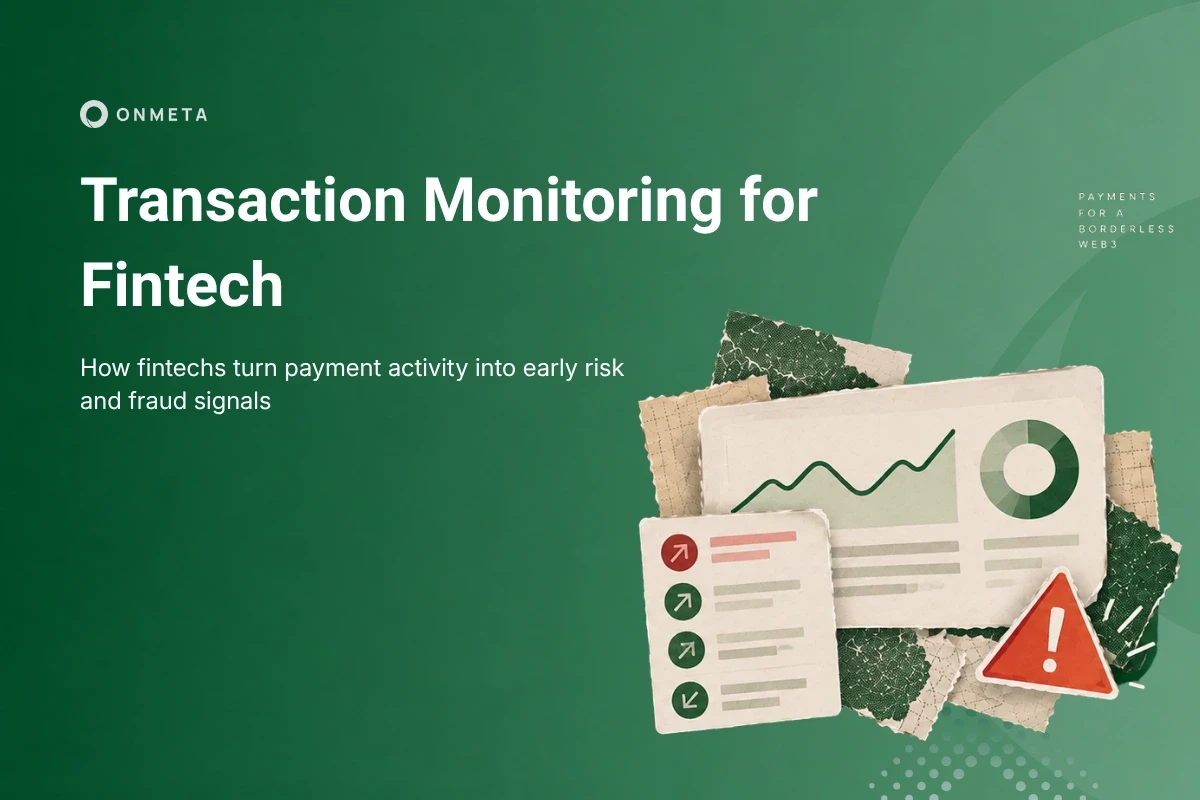
Transaction monitoring is the process of analysing customer transactions and related risk signals to identify activity that may be unusual, suspicious or require further investigation.
For fintechs and payment platforms, this monitoring continues after customer onboarding. A customer may pass identity and KYC checks but later show transaction behaviour that differs significantly from their expected activity.
Effective transaction monitoring brings payment data, customer context, rules and risk signals together. The goal is not simply to generate alerts. It is to identify meaningful risk, investigate it efficiently and determine when further action is required.
Key Takeaways on Transaction Monitoring
Transaction monitoring analyses payment activity to identify unusual or potentially suspicious behaviour.
Effective monitoring combines transaction data with customer, behavioural, geographic and counterparty context.
Rules and risk signals generate alerts, but an alert itself does not prove that financial crime has occurred.
Automated and real-time transaction monitoring can help fintechs manage large transaction volumes more efficiently.
A strong system should measure false positives, investigation efficiency and detection coverage rather than focusing only on the number of alerts generated.
How Does Transaction Monitoring Work?
Transaction monitoring begins with transaction data, but a useful monitoring system needs more than the amount of money being moved.
The process generally involves six stages:
Collect transaction data: The system receives information such as transaction amount, time, currency, payment method, sender, recipient and status.
Add customer context: Customer risk level, account history, geography and expected activity provide context around the transaction.
Apply rules and risk signals: The transaction is evaluated against predefined rules, thresholds, behavioural patterns or other risk indicators.
Generate alerts: Activity meeting relevant monitoring criteria can trigger an alert for additional assessment.
Investigate: Compliance or risk teams review the transaction alongside customer history and other relevant information.
Escalate or close: Depending on the findings, the alert may be closed, escalated for additional investigation or handled according to applicable reporting and compliance procedures.
This context matters. A transaction amount that is completely normal for one customer may be highly unusual for another.
What Does a Transaction Monitoring System Look For?
A transaction monitoring system looks for activity that differs from expected behaviour or matches patterns associated with higher risk.
Signal | Example Risk |
Unusual amount | Activity significantly outside normal customer behaviour |
High velocity | Multiple transactions within a short period |
Geographic anomaly | Unexpected location or payment corridor |
Behaviour change | Sudden deviation from the customer's previous activity |
Counterparty risk | Unusual or higher risk relationship |
Transaction frequency | Unexpected increase in payment activity |
Network pattern | Connections between accounts or transactions that require review |
Individual signals do not automatically mean a transaction is suspicious.
For example, sending several payments quickly may be normal for a business account but unusual for a customer who historically makes one transaction each month. Transaction monitoring becomes more useful when these signals are interpreted within the customer's broader context.
Why Is Transaction Monitoring Important for Fintechs?
Fintechs can process large numbers of transactions across customers, payment methods and markets. Manually reviewing every transaction is neither practical nor particularly useful.
Transaction monitoring helps fintechs identify activity that may require attention while allowing normal payments to continue without unnecessary intervention.
It can support several important functions:
Identifying potentially suspicious financial activity
Monitoring customer risk after onboarding
Managing large payment volumes
Supporting AML compliance operations
Detecting meaningful changes in customer behaviour
Investigating unusual payment patterns
Monitoring cross-border transactions
This is particularly important because customer risk is not static. A customer's identity may remain the same while their transaction behaviour changes substantially.
For businesses dealing with fraud linked payment chains, monitoring can also provide context around counterparties and fund movement. OnMeta's guide to P2P payment fraud and frozen bank accounts explains how apparently legitimate transactions can become connected to wider fraud activity.
Transaction Monitoring vs Fraud Detection
Transaction monitoring and fraud detection can analyse some of the same payment data, but their primary objectives differ.
Transaction Monitoring | Fraud Detection |
Focuses on unusual or potentially suspicious transaction activity | Focuses on identifying fraudulent behaviour |
Commonly supports financial crime and AML controls | Primarily aims to prevent or reduce fraud losses |
May examine activity across a longer customer relationship | Can make immediate decisions around individual transactions |
Can trigger compliance investigation | Can trigger additional authentication, holds or declines |
Considers customer and transaction risk | Often considers identity, device, behavioural and payment fraud signals |
The two systems can overlap. A compromised account, for example, may generate both fraud signals and unusual transaction patterns.
The distinction matters because a fraud decision and an AML investigation may lead to different operational and compliance responses.
Transaction Monitoring vs AML Compliance
Transaction monitoring is an important AML control, but the two terms should not be treated as interchangeable.
Transaction Monitoring | AML Compliance |
Analyses transaction activity | Covers the broader financial crime compliance framework |
Identifies unusual patterns | Identifies and manages wider money laundering risks |
Generates alerts for investigation | Includes risk assessment, CDD, screening, monitoring and reporting |
Primarily focuses on activity after transactions begin | Extends across the customer lifecycle |
Transaction monitoring is a control within the broader AML compliance framework.
An effective AML program can also include customer identification, customer due diligence, enhanced due diligence, sanctions screening, investigations, reporting, record keeping and ongoing risk assessment.
For more context on how these controls work together, OnMeta's guide to crypto payment compliance, KYC and AML explains the broader compliance framework.
What Are Common Transaction Monitoring Rules?
Rules help monitoring systems identify activity that meets predefined risk conditions.
Common categories include:
Amount Rules
These identify transactions that exceed relevant thresholds or differ significantly from the customer's typical transaction size.
Velocity Rules
Velocity monitoring looks for unusually rapid activity, such as multiple transfers occurring within a short period.
Frequency Rules
These identify significant changes in how frequently a customer transacts.
Geographic Rules
Transactions involving unexpected locations or corridors can receive additional scrutiny based on the business's risk framework.
Behavioural Rules
These compare current activity with a customer's established transaction behaviour.
Counterparty Rules
Monitoring can consider who a customer is sending money to or receiving money from and whether those relationships create additional risk.
Pattern and Network Rules
Rather than analysing transactions individually, these rules can look for relationships between accounts, counterparties and movements of funds.
Rules should not remain static forever. As products, customers and risk patterns change, monitoring logic needs to be reviewed and adjusted.
Real-Time vs Batch Transaction Monitoring
Transaction monitoring can happen immediately or after transactions have been grouped for later analysis.
Real Time Monitoring | Batch Monitoring |
Analyses activity as transactions occur | Analyses transactions periodically |
Can support immediate risk decisions | Useful for reviewing broader historical patterns |
Suitable where rapid intervention may be required | Suitable for patterns that become visible over time |
Requires fast data processing and decisioning | Can process larger datasets together |
Neither approach automatically replaces the other.
Real-time transaction monitoring can help identify activity requiring immediate attention, while batch monitoring can reveal patterns that are difficult to identify from an individual transaction. A fintech may use both depending on its products, risks and compliance requirements.
How Automated Transaction Monitoring Works
Automated transaction monitoring helps fintechs process transaction volumes that would be unrealistic to review manually.
A typical system includes several connected functions:
Data ingestion: Transaction and relevant customer data enter the monitoring system.
Rules engine: Transactions are evaluated against configured monitoring scenarios and thresholds.
Risk scoring: Relevant signals can be combined to estimate the level of risk associated with activity.
Alert generation: Activity meeting specified criteria creates an alert.
Case management: Related alerts and supporting information can be organised into investigation workflows.
Human review: Analysts assess cases that require judgement, escalation or additional investigation.
Automation therefore does not mean automatically deciding that every flagged transaction is suspicious.
Its real value is narrowing large volumes of payment activity into a smaller set of events that deserve closer attention.
How AI Is Changing Transaction Monitoring
AI and machine learning can help transaction monitoring systems analyse behaviour beyond fixed rules.
Potential applications include:
Anomaly detection
Behavioural analysis
Pattern recognition
Alert prioritisation
Risk scoring
Network analysis
False positive reduction
For example, behavioural analysis can help identify when activity differs substantially from a customer's established patterns even when no simple transaction threshold has been crossed.
AI can also help prioritise alerts by combining multiple risk signals, allowing investigators to focus attention on cases presenting greater risk.
But AI does not remove the need for compliance analysts. Models can produce incorrect results, customer behaviour can change for legitimate reasons, and higher risk decisions may require contextual judgement.
The better approach is to use technology to improve detection and investigation while maintaining appropriate governance and human oversight.
How to Measure Transaction Monitoring Performance
A monitoring system that generates thousands of alerts is not necessarily performing well. Human beings remain stubbornly capable of creating dashboards where bigger numbers look impressive even when they mostly represent extra work.
Useful transaction monitoring metrics include:
Alert volume: How many alerts the system generates.
False positive rate: How frequently alerts represent legitimate activity.
Alert-to-case conversion: How many alerts require meaningful investigation.
Investigation time: How long analysts take to review and resolve cases.
Rule effectiveness: Whether monitoring scenarios are identifying relevant activity.
Detection coverage: Whether important risk patterns are adequately monitored.
These metrics should be evaluated together.
Reducing alerts is not automatically an improvement if meaningful risk is being missed. Similarly, increasing alert volumes does little good if analysts spend most of their time closing low-value cases.
The goal is to generate better risk signals, not simply more alerts.
Choosing a Transaction Monitoring System
Fintechs should evaluate transaction monitoring systems based on how well they fit the company's payment flows, markets and risk framework.
Important capabilities include:
Comprehensive transaction and customer data coverage
Real-time monitoring where required
Configurable rules and thresholds
Risk scoring
Behavioural analysis
Alert management
Case management
Audit trails
API and system integrations
Reporting
Multi-market support
Scalability
Integration deserves particular attention. A monitoring system becomes less useful when transaction data, customer risk information and investigation records are fragmented across disconnected platforms.
Teams should also understand how easily rules can be updated, whether analysts can understand why alerts were generated and how monitoring decisions are recorded for later review.
Transaction Monitoring for Global Fintech & Web3 Platforms
Global fintech and Web3 platforms may need to monitor activity across multiple payment rails, currencies, digital assets, wallets and customer profiles.
Cross-border activity adds further context. A payment corridor may be completely normal for one customer group but unexpected for another. Digital asset transactions can also introduce wallet and blockchain data alongside traditional fiat payment information.
For businesses using fiat and digital asset infrastructure, OnMeta's on-ramp and off-ramp infrastructure connects supported local payment methods with digital asset transactions. Its cross-border payouts to INR infrastructure similarly supports eligible payout flows into India.
These payment flows can generate data relevant to compliance and risk processes, but transaction monitoring remains part of the business's wider AML and financial crime framework. The appropriate monitoring controls depend on its products, markets, customers and applicable regulatory requirements.
Conclusion: Better Monitoring Means Better Risk Context
Transaction monitoring is not about treating every unusual payment as suspicious. It is about identifying activity that deserves attention and giving compliance teams enough context to understand why.
Effective systems combine transaction information with customer risk, historical behaviour, geography, counterparties and other relevant signals. Rules and automation can identify patterns at scale, while case management and human investigation help determine what those patterns actually mean.
For fintech and Web3 businesses, this becomes increasingly important as payment volumes, markets and financial infrastructure expand. Real-time monitoring, behavioural analysis and automation can make the process more efficient, but the objective remains fairly simple: turn payment data into useful risk signals without drowning compliance teams in meaningless alerts.
Frequently Asked Questions
1. How do you reduce false positives in transaction monitoring?
False positives can be reduced by combining transaction rules with customer risk, historical behaviour, counterparty information and other relevant context. Rules and thresholds should also be tested and adjusted as transaction patterns change.
2. How often should transaction monitoring rules be updated?
There is no universal schedule for every fintech. Rules should be reviewed regularly and when products, customer behaviour, markets, regulations or identified financial crime risks change materially.
3. What data is needed for transaction monitoring?
Transaction monitoring can use payment amounts, timestamps, currencies, counterparties, customer risk information, transaction history, geographic data and behavioural patterns. The exact data required depends on the monitoring scenarios and business model.
4. Can a small fintech outsource transaction monitoring?
A fintech may use third-party technology or service providers to support transaction monitoring, depending on applicable requirements. Outsourcing technology or operations does not necessarily transfer the fintech's underlying regulatory responsibilities.
5. What happens after a transaction monitoring alert is triggered?
An alert is typically reviewed alongside relevant customer and transaction information. Depending on the findings, it may be closed, investigated further, escalated or handled according to applicable compliance and reporting procedures.
Last Updated: September 2026
Author