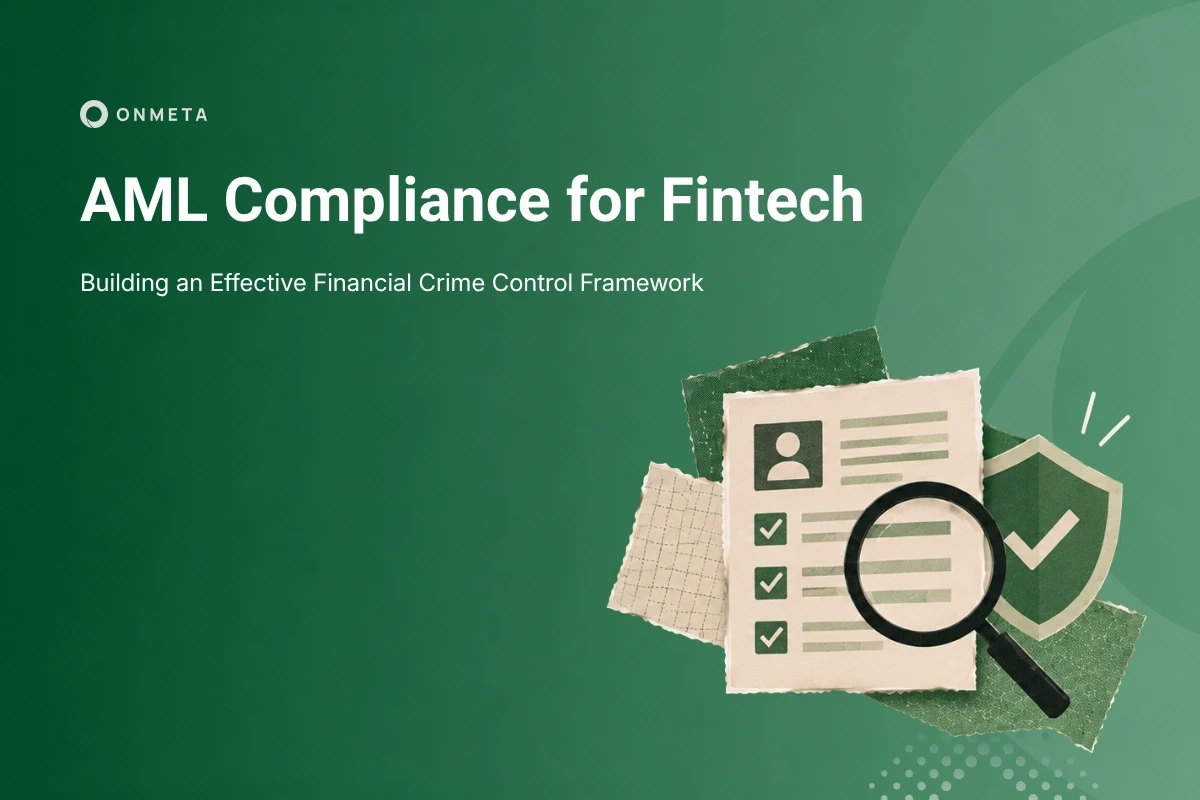
AML Compliance for Fintech: Building an Effective Financial Crime Control Framework

Risk & Compliance Head
Overview: AML Compliance for Fintech Companies
For fintechs, AML compliance is not simply about collecting identity documents when a customer signs up. Financial crime risk can change after onboarding as customers begin transacting, enter new markets, use different products or interact with new counterparties.
AML compliance is the policies, controls, processes and monitoring systems a financial business uses to identify and mitigate money laundering and related financial crime risks.
An effective AML program therefore needs to cover the customer lifecycle. It starts with understanding the risks a business faces, continues through customer due diligence and screening, and extends into transaction monitoring, investigations, reporting and ongoing review.
In this guide, we will look at the core components of AML compliance, how a risk-based approach works, where transaction monitoring fits, and how fintechs can build a practical financial crime control framework.
Key Takeaways on AML Compliance
AML compliance extends beyond KYC and requires controls throughout the customer relationship.
An effective AML program starts by identifying and assessing the financial crime risks relevant to the business.
Customer due diligence, sanctions screening, transaction monitoring, investigations, and reporting perform different but connected functions.
Higher risk relationships may require enhanced due diligence and closer monitoring rather than identical controls for every customer.
Technology can automate parts of AML compliance, but governance, risk management and human oversight remain important.
What Is AML Compliance?
AML compliance refers to the framework a financial business uses to identify, assess and mitigate risks associated with money laundering and related financial crime.
Depending on the business and applicable regulatory framework, an AML program may also need to address terrorist financing and proliferation financing risks. FATF's international standards place the risk-based approach at the centre of AML/CFT frameworks, requiring relevant financial institutions to identify and understand their risks and apply measures proportionate to them.
Several controls work together within this framework:
Component | Purpose |
KYC | Establishes customer identity |
Customer due diligence | Understands the customer and associated risk |
AML monitoring | Identifies potentially suspicious activity |
Sanctions screening | Checks relevant persons or entities against applicable sanctions controls |
Transaction monitoring | Identifies unusual or suspicious transaction patterns |
Reporting | Escalates or reports qualifying activity according to applicable requirements |
KYC is therefore part of AML compliance, not a replacement for it. OnMeta's guide to crypto payment compliance, KYC and AML covers these concepts in greater detail.
Why AML Compliance Matters for Fintech Companies
Fintechs can move money quickly, serve customers digitally and operate across multiple payment methods and markets. Those advantages also mean financial crime controls need to keep pace with how the product actually works.
AML compliance helps businesses identify risks associated with customers, products, transactions, geographies and counterparties. It can also be important when working with banks, payment partners and other regulated financial infrastructure.
A risk-based approach does not mean treating every customer or transaction as equally suspicious. FATF states that financial institutions should have processes to identify, assess, monitor, manage and mitigate money laundering and terrorist financing risks. Higher risk situations should receive enhanced measures, while lower risk situations may allow proportionate simplified measures where permitted.
For a growing fintech, that approach also makes operational sense. Compliance resources can be directed toward the relationships and activities presenting greater risk rather than creating unnecessary friction everywhere.
What Are the Core Components of an Effective AML Program?
An AML program works best as a connected framework rather than a collection of independent checks.
AML Component | What It Does |
Enterprise risk assessment | Identifies and measures financial crime exposure |
Customer identification | Establishes who the customer is |
Customer due diligence | Determines the customer's risk profile |
Enhanced due diligence | Applies additional measures to higher risk relationships |
Sanctions screening | Screens customers and relevant transactions against applicable lists |
Transaction monitoring | Identifies unusual or potentially suspicious activity |
Case management | Organises investigation of alerts |
Suspicious activity reporting | Escalates qualifying activity under applicable requirements |
Record keeping | Maintains evidence of compliance activity |
Ongoing monitoring | Keeps customer information and risk assessments current |
The AML risk assessment provides the foundation. A fintech needs to understand where financial crime exposure can arise across its customers, products, payment methods, markets and transaction activity before deciding which controls are appropriate.
Customer identification and CDD then establish who the customer is and help the business understand the relationship. FATF's customer due diligence standards include identifying and verifying customers using reliable, independent information and identifying beneficial owners where applicable.
Monitoring continues after onboarding. Transactions and customer activity can produce new risk signals that were not present when the account was opened. Alerts may require investigation, escalation or reporting depending on their circumstances and applicable rules.
The result is an AML program that evolves with customer behaviour rather than treating onboarding as the finish line.
How Does a Risk-Based AML Approach Work?
A risk-based approach adjusts the intensity of AML controls according to the risks identified.
A lower-risk customer may be handled using standard controls permitted under the applicable framework. A customer presenting additional risk factors may require closer monitoring or more information. Higher risk relationships may require enhanced due diligence, additional review and stronger controls.
Factors considered in an AML risk assessment can include:
Customer type
Geography
Product or service used
Transaction behaviour
Delivery channel
Source of funds where relevant
Beneficial ownership
Nature and purpose of the relationship
Higher risks require stronger measures, while controls should not become indiscriminate de-risking of entire customer categories.
This also means there is no universal customer risk model that every fintech can copy. The appropriate controls depend on the company's products, jurisdictions, customers and applicable regulatory requirements.
AML Compliance Process: From Customer Onboarding to Ongoing Monitoring
AML compliance begins before a customer starts transacting and continues throughout the relationship.
A typical process can include:
Customer onboarding: Collect the information required to establish the relationship.
Identity verification: Verify relevant customer identity information using appropriate sources and methods.
KYC and CDD: Understand the customer, purpose of the relationship and relevant risk factors.
Screening: Perform applicable sanctions and other required screening.
Risk assessment: Assign an appropriate customer risk level using available information.
Account activation: Allow the customer to use relevant services once required checks are complete.
Transaction monitoring: Review activity for unusual or potentially suspicious behaviour.
Alert investigation: Examine relevant alerts and supporting customer or transaction context.
Escalation and reporting: Escalate or report qualifying activity according to applicable procedures and regulations.
Ongoing review: Update customer information and risk assessments when appropriate.
Some studies describe identification, verification and monitoring as interrelated elements of customer due diligence rather than isolated exercises.
The exact sequence and controls can vary by business model and jurisdiction, but the underlying principle remains the same: customer risk needs to be understood beyond the initial signup.
How Transaction Monitoring Supports AML Compliance
Transaction monitoring helps fintechs identify activity that may require further investigation after a customer has been onboarded.
A monitoring system can consider factors such as:
Transaction frequency and velocity
Transaction amounts
Geographic patterns
Counterparties
Changes in account behaviour
Movement of funds
Historical transaction activity
Traditional systems often use predefined rules and thresholds to generate alerts. More advanced approaches can supplement these controls with behavioural analytics and other risk signals.
An alert does not automatically mean a transaction is criminal. It indicates that activity meets criteria requiring additional assessment. Investigators then need enough customer and transaction context to determine what action is appropriate.
This is why transaction monitoring should connect with customer risk information rather than operating as an isolated alert generator.
AML Compliance Challenges for Fintechs
The difficulty of AML compliance increases as a fintech adds customers, products, markets and payment methods.
One major problem is false positives. Broad rules can generate large numbers of alerts, leaving compliance teams to investigate legitimate activity alongside genuinely suspicious cases. Fragmented data can make those investigations even harder when identity, payment and account information sit in different systems.
Other challenges include:
High alert volumes
Cross-border transactions
Rapidly changing fraud patterns
Synthetic identities
Digital asset activity
Real-time payments
Manual investigation workloads
Different regulatory requirements across markets
Balancing compliance controls with customer experience
Fraud and money laundering risks can also intersect. An account receiving fraud-linked funds, for example, may create both fraud and financial crime concerns depending on the circumstances.
OnMeta's guide to P2P payment fraud and frozen bank accounts looks more closely at how payment activity can become connected to fraud-linked transaction chains.
How Technology Is Changing AML Compliance
AML technology increasingly helps compliance teams process larger volumes of customer and transaction information without requiring every decision to be handled manually.
Technology can support:
Automated KYC and CDD workflows
Transaction monitoring
Sanctions screening
Customer risk scoring
Graph and network analysis
Behavioural analytics
Machine learning-assisted detection
Case management
Regulatory reporting workflows
Graph analysis, for example, can help teams examine relationships between accounts, transactions and counterparties that may be difficult to identify from individual transactions.
Machine learning can also support pattern detection and alert prioritisation, but it should not be treated as a substitute for an AML framework.
Technology can automate detection and investigation workflows, but effective AML programs still require appropriate governance, risk management and human oversight.
The point is not to automate every compliance decision. It is to give compliance teams better information and reduce unnecessary manual work where appropriate.
How to Build an AML Compliance Framework for a Fintech
Building an AML framework starts with understanding the business rather than buying software and hoping the software figures everything out. Technology remains stubbornly unwilling to replace governance by magic.
Step 1: Conduct an AML Risk Assessment
Assess the financial crime risks associated with customers, products, geographies, payment methods and business operations.
Step 2: Define Customer Risk Categories
Create a methodology for determining customer risk and identifying relationships that may require additional controls.
Step 3: Establish KYC and CDD Procedures
Define what customer information needs to be collected, verified and maintained under applicable requirements.
Step 4: Implement Screening Controls
Establish relevant sanctions and other screening processes based on the company's regulatory obligations.
Step 5: Configure Transaction Monitoring
Develop monitoring scenarios based on the transaction patterns and risks relevant to the business.
Step 6: Create Investigation Workflows
Define how alerts are reviewed, documented, escalated and closed.
Step 7: Establish Reporting Procedures
Create processes for escalating and reporting qualifying suspicious activity to the appropriate authority where required.
Step 8: Establish Governance and Accountability
Clearly define ownership of the AML program, decision-making responsibilities and management oversight.
Step 9: Test and Tune Controls
Review whether rules, thresholds and monitoring systems are identifying relevant risk without creating unnecessary alert volumes.
Step 10: Review the Framework Continuously
Customer behaviour, products and financial crime risks change. AML controls should be reviewed and updated accordingly. FATF describes risk understanding as an ongoing and dynamic process that should respond to changing information and emerging risks.
AML Compliance for Global Fintechs Operating Across Markets
Fintechs operating across the United States and markets such as Singapore, Indonesia, the Philippines, Malaysia, Vietnam and Thailand cannot assume that one AML setup automatically satisfies every market.
Requirements can differ across customer identification, reporting, sanctions implementation, transaction monitoring and local financial infrastructure. Risk profiles can also change based on the products and payment rails available in each country.
A global fintech therefore needs a consistent internal financial crime framework with enough flexibility to meet applicable local requirements.
This becomes particularly important for businesses connecting fiat and digital asset infrastructure. OnMeta's guide to building fiat on-ramp and off-ramp infrastructure in India explains how payment infrastructure, compliance and local rails come together in one market.
The implementation for any jurisdiction should ultimately be based on current local requirements rather than treating a global AML framework as jurisdiction-specific legal advice.
Conclusion: AML Compliance Is an Ongoing Risk Management Process
AML compliance works best when it is treated as an ongoing financial crime risk management process rather than a one-time onboarding requirement.
A fintech needs to understand its risk exposure, identify and verify customers, perform appropriate due diligence, monitor activity, investigate meaningful alerts and maintain clear escalation and reporting procedures. The controls should also evolve as the business enters new markets, introduces products or encounters new patterns of customer behaviour.
Technology can make that framework more scalable, particularly through automated verification, screening, transaction monitoring and case management. But the quality of an AML program still depends on how well those tools are connected to risk assessment, governance and human decision-making.
For fintech and Web3 businesses using payment infrastructure such as OnMeta, these AML controls form part of the wider compliance environment surrounding fiat and digital asset transactions. The infrastructure can support specific compliance and payment workflows, while each business remains responsible for understanding and meeting the requirements applicable to its own activities.
FAQs About AML Compliance
What is the difference between AML and KYC?
KYC focuses on identifying and understanding customers, while AML is the broader framework used to manage money laundering and related financial crime risks. KYC and customer due diligence are therefore components of a wider AML program.
How much does AML compliance cost for a fintech?
AML compliance costs depend on factors such as customer volume, markets, products, staffing, verification requirements, monitoring infrastructure and regulatory obligations. There is no standard cost that applies to every fintech.
What happens if a fintech does not have an effective AML program?
Depending on the jurisdiction and activities involved, AML deficiencies can lead to regulatory action, remediation requirements, financial penalties, restrictions on business activities and problems with banking or payment partners.
How often should an AML risk assessment be updated?
There is no universal interval for every fintech. Risk assessments should be reviewed according to applicable requirements and when material changes occur in products, customers, markets, transaction patterns or financial crime risks.
What makes a customer high risk for AML purposes?
Customer risk can depend on several factors, including geography, business activity, ownership structure, products used, source of funds and transaction behaviour. A single factor does not necessarily make every customer high risk.
Can AML compliance be automated?
Parts of AML compliance can be automated, including identity checks, screening, transaction monitoring, risk scoring and case workflows. Governance, investigation and risk-based decision-making still require appropriate human oversight.
What is the difference between transaction monitoring and AML compliance?
Transaction monitoring focuses on identifying unusual or potentially suspicious financial activity. AML compliance is broader and includes risk assessment, KYC, customer due diligence, screening, transaction monitoring, investigations, reporting, record-keeping, and ongoing review.
Last Updated: September 2026
Author