Payment Orchestration: Why Global Businesses Are Moving Beyond Single PSP Infrastructure

Product Manager
Overview: Payment Orchestration for Global Businesses
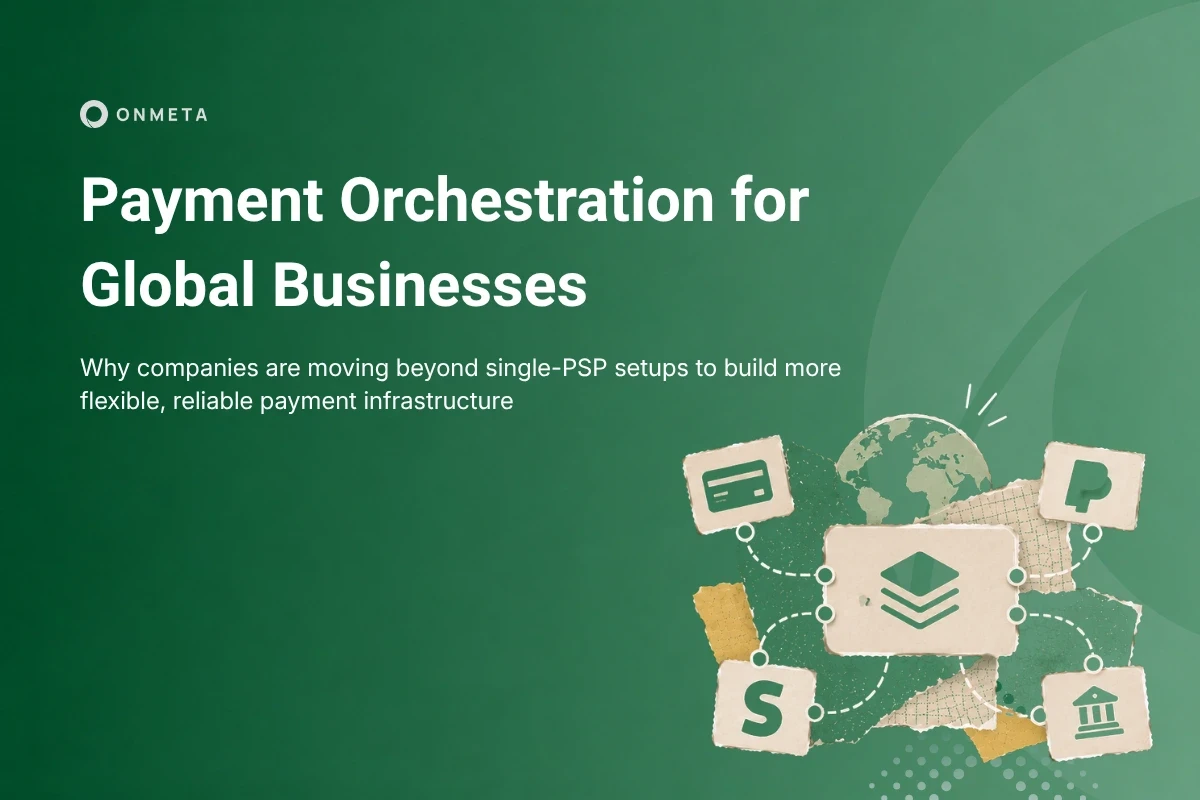
Payment orchestration is the process of managing multiple payment providers, methods, and transaction flows through a centralised technology layer. Instead of sending every payment through a single payment service provider, businesses can use an orchestration layer to decide how different transactions should be processed.
This becomes increasingly useful as businesses expand across markets. A single PSP may not provide the same payment methods, geographic coverage or performance everywhere. Adding more providers can solve some of those limitations, but it also creates a new problem: managing them all.
Payment orchestration addresses that complexity by giving businesses a central layer for payment routing, failover, transaction data and payment optimisation.
In this guide, we will look at how payment orchestration works, why businesses move beyond single PSP infrastructure, how smart payment routing works, and what to consider when choosing a payment orchestration provider.
Key Takeaways on Payment Orchestration
Payment orchestration provides a centralised layer for managing multiple PSPs, acquirers and payment methods.
Businesses can use payment routing rules to select providers based on geography, currency, availability and other relevant factors.
Multi-PSP infrastructure can reduce dependency on a single provider and provide failover options when one route becomes unavailable.
Payment orchestration can centralise payment data, reporting and operational controls across otherwise fragmented providers.
The value of orchestration generally increases as a business adds markets, payment methods, currencies and payment providers.
What Is Payment Orchestration?
Payment orchestration is a technology layer that connects a business with multiple payment providers, acquirers and payment methods while centrally managing how transactions are routed and processed.
Without orchestration, a business may integrate directly with individual PSPs. Each integration can have its own API, payment methods, reporting system, settlement process and operational requirements.
A payment orchestration layer sits between the merchant's payment experience and these underlying providers. Rather than rebuilding the payment logic every time another PSP or payment method is added, the business can manage multiple connections through a common infrastructure layer.
Depending on the platform, payment orchestration can support payment routing, retries, failover, reporting, transaction management and payment analytics.
It does not eliminate PSPs or acquirers. It coordinates how a business uses them.
How Does Payment Orchestration Work?
When a customer initiates a payment, the orchestration layer receives the relevant transaction information and determines how the payment should be processed.
A typical process looks like this:
Payment initiation: The customer chooses a payment method and provides the information required to complete the transaction.
Transaction evaluation: The orchestration layer evaluates factors such as payment method, currency, geography and configured routing rules.
Payment routing: The transaction is sent to an appropriate PSP or acquiring route.
Authorisation: The selected provider processes the transaction through the relevant payment infrastructure and returns the result.
Retry or failover: Where supported and appropriate, a failed attempt may be routed through another available provider.
Transaction recording: Payment status and relevant transaction data are centralised for reporting, reconciliation and analysis.
Settlement: Funds are settled according to the arrangements between the business and the providers involved.
The exact process depends on the payment orchestration provider and payment method being used.
The important distinction is that the merchant is no longer forced to send every eligible payment through one predetermined provider.
Why Are Businesses Moving Beyond a Single PSP?
A single PSP can be perfectly adequate for a business operating with relatively simple payment requirements. Problems tend to appear as the business expands.
Single PSP | Multi PSP + Orchestration |
Single provider dependency | Multiple provider options |
Limited routing options | Dynamic payment routing |
Provider-specific coverage | Broader payment coverage |
Greater dependency on one provider's availability | Failover options |
Limited optimization between providers | Performance-based routing |
If a single provider experiences downtime or does not support an important local payment method, the business has limited alternatives.
Adding another PSP can improve resilience and coverage, but direct integrations create their own operational burden. Engineering teams must maintain multiple APIs, while finance and operations teams may have to reconcile data from several systems.
Payment orchestration is designed to manage that multi-provider environment more centrally.
What Problems Does Payment Orchestration Solve?
The main purpose of payment orchestration is not simply to add more PSPs. It is to make multiple payment relationships manageable.
PSP Dependency
Businesses relying entirely on one provider inherit that provider's availability, coverage and technical limitations. Multi-provider infrastructure gives businesses additional routes when appropriate.
Failed Transactions
Some orchestration platforms can retry eligible failed payments or use alternative providers. This can support payment recovery, although not every failed payment should or can be retried.
Payment Routing
Different transactions may perform differently depending on currency, geography, payment method or provider. Routing gives businesses greater control over which eligible provider receives a transaction.
Geographic Coverage
A PSP with strong coverage in one market may offer limited options in another. Multiple providers can make it easier to support regional requirements.
Local Payment Methods
Payment preferences vary substantially by market. Orchestration can make it easier to manage different payment methods without building completely separate infrastructure for each one.
Operational Complexity
Multiple integrations create fragmented transaction data, dashboards and workflows. A centralised orchestration layer can bring more of that activity into a common operational view.
Payment Orchestration vs Payment Gateway
A payment gateway and payment orchestration platform can both sit within payment infrastructure, but they perform different functions.
Payment Gateway | Payment Orchestration |
Connects a business to payment processing | Coordinates multiple payment providers |
Usually focuses on a particular provider or payment flow | Focuses on multi-provider infrastructure |
Transmits payment information for processing | Adds routing, failover and optimisation logic |
Can provide access to supported payment methods | Can coordinate methods and routes across providers |
A gateway can therefore be one component within a wider payment setup that also uses orchestration.
Businesses building digital asset payment infrastructure face similar decisions around APIs, payment methods, settlement and provider architecture. OnMeta's guide to how crypto payment gateways work explores that infrastructure in more detail.
How Does Smart Payment Routing Work?
Payment routing determines which available provider or processing route should handle a particular transaction.
Instead of routing every transaction through the same PSP, businesses can configure logic using factors such as:
Customer or transaction geography
Currency
Payment method
PSP availability
Transaction type
Historical provider performance
Processing cost
Payment authorisation performance
The routing logic depends on what the business is trying to optimise.
A business might prioritise a provider with strong local payment coverage for transactions in a particular market. Another route might be selected because the primary provider is temporarily unavailable.
Historical performance can also inform routing decisions, provided the data is relevant to the transaction being evaluated.
Cost is another consideration, but automatically choosing the cheapest provider is not necessarily optimal. A cheaper route with weaker authorisation performance, limited payment coverage or poor reliability could create higher costs elsewhere.
Effective payment optimisation therefore considers several factors rather than reducing routing to one metric.
What Are the Benefits of Payment Orchestration?
The practical benefits depend on the business's existing payment infrastructure, but orchestration can provide several advantages.
Higher Payment Resilience
Multiple provider connections can give businesses alternative routes when one provider is unavailable, subject to the payment method and transaction circumstances.
Broader Payment Method Coverage
Businesses can combine the payment methods available across different PSPs rather than relying entirely on one provider's coverage.
Reduced PSP Dependency
A multi-provider strategy reduces the operational dependence created when every transaction relies on a single external provider.
Better Routing Control
Businesses can create payment routing rules that reflect geography, currencies, payment methods, availability and performance.
Faster Market Expansion
Existing orchestration infrastructure can make it easier to connect additional regional providers when entering new markets, although regulatory, commercial and technical integrations may still be required.
Centralised Payment Operations
Payment information from different providers can be brought into a more consistent operational environment.
Better Payment Data Visibility
Centralised payment data can support payment analytics, performance comparisons, reconciliation and optimisation decisions.
Payment Orchestration for Global Businesses
Payment infrastructure becomes significantly more complicated when a business operates across multiple countries.
A company serving customers in the US and Southeast Asian markets such as Singapore, Indonesia, the Philippines, Vietnam, Malaysia and Thailand may need to support different currencies, payment methods, banking systems and regional providers.
A single global PSP may cover several markets but still lack an important local payment method or optimal route in a particular country. At the other extreme, integrating directly with a separate provider for every market can leave businesses maintaining a small museum of payment integrations.
Payment orchestration creates a layer between these extremes. Businesses can connect multiple providers while managing routing and payment data more centrally.
The same principle can apply when fiat and digital asset infrastructure intersect. OnMeta's on-ramp and off-ramp infrastructure, for example, supports local fiat and digital asset flows across supported markets and payment methods.
The broader lesson is that global payment architecture needs to accommodate local rails without turning every new market into a completely separate technical system.
How to Choose a Payment Orchestration Platform
Not every business needs the same orchestration capabilities. The right platform depends on existing PSP relationships, markets, transaction volumes and payment methods.
Important areas to evaluate include:
PSP coverage: Which existing and potential providers can be connected?
Payment method coverage: Does the platform support the methods customers actually use?
Routing controls: How much flexibility does the business have when creating routing logic?
Failover: What happens when a provider or route becomes unavailable?
API quality: How straightforward is the platform to integrate and maintain?
Reporting: Can teams analyse payment performance across providers?
Reconciliation support: How are transaction and settlement records managed?
Fraud and risk integrations: Can payment decisions interact with relevant risk systems?
Geographic coverage: Does the infrastructure fit current and planned markets?
Scalability: Can it support increasing payment volumes and infrastructure complexity?
Businesses should also understand how much control they retain over provider relationships and transaction data.
A platform that simplifies integration but creates another rigid dependency merely moves the original problem somewhere else, which is an impressively human way to solve infrastructure complexity.
Payment Orchestration and Modern Fintech Infrastructure
Payment orchestration does not operate independently from the rest of a fintech's technology stack.
A modern payment environment can include payment APIs, gateways, PSPs, fraud controls, compliance systems, transaction monitoring, reconciliation and local payment rails. Orchestration helps coordinate the payment layer across some of these systems.
Fraud prevention systems, for example, can provide risk signals that influence how a payment is handled. Transaction monitoring can analyse activity after payments begin flowing through the platform. Reconciliation systems then help finance teams match transaction and settlement information across providers.
For regulated or higher-risk financial products, payment infrastructure also needs to work alongside appropriate KYC and AML controls. OnMeta's crypto payment compliance, KYC and AML guide explains how those controls fit into digital asset payment infrastructure.
The goal is not to make one platform responsible for every part of the payment stack. It is to make sure those systems can exchange the data and signals required to operate effectively.
Conclusion: Building Payment Infrastructure Beyond a Single Provider
Payment orchestration becomes valuable when payment complexity starts exceeding what a single provider can efficiently support.
By placing a centralised layer between the business and multiple PSPs, acquirers and payment methods, businesses can gain more control over payment routing, provider failover, transaction data and payment operations.
For global fintech and digital businesses, that flexibility becomes increasingly relevant as they expand into markets with different currencies, payment methods and local infrastructure. The objective is not simply to connect as many PSPs as possible. It is to build a payment architecture where those connections can be managed intelligently.
OnMeta fits into this broader infrastructure by providing supported fiat on-ramp and off-ramp capabilities that connect local payment methods with digital asset flows. For businesses building across traditional and digital payment infrastructure, orchestration, risk controls and local payment connectivity can each solve different parts of the same increasingly complicated payment stack.
FAQs: Payment Orchestration
1. When does a business actually need payment orchestration?
Payment orchestration becomes particularly useful when a business works with multiple PSPs, operates across several markets, supports different payment methods or needs more control over routing and provider failover. Smaller businesses with simple payment requirements may not need a dedicated orchestration layer.
2. Does payment orchestration reduce payment processing costs?
It can help businesses route payments using cost as one factor and provide better visibility into provider performance. However, payment orchestration does not automatically reduce processing costs, and routing solely through the cheapest provider may not produce the best overall payment outcome.
3. Can payment orchestration improve authorisation rates?
Payment orchestration can support authorisation optimisation by routing eligible transactions based on relevant provider and transaction performance data. Actual authorisation outcomes still depend on factors such as the payment method, issuer, customer, transaction and provider.
4. How difficult is it to integrate multiple PSPs?
The complexity depends on the number of providers, APIs, payment methods, markets and operational requirements involved. An orchestration layer can centralise parts of this integration, but individual provider onboarding and commercial requirements may still apply.
5. Does payment orchestration replace a payment gateway?
Not necessarily. A payment gateway primarily connects payment information with processing infrastructure, while payment orchestration coordinates transactions across multiple providers and routes. A business may use both within the same payment stack.
6. What happens if a payment provider goes down?
If alternative providers are integrated and the transaction is eligible for another route, an orchestration system can use configured failover logic to send the payment through another available provider. The exact behaviour depends on the payment method, provider setup and orchestration rules.
Last Updated: September 2026
Author