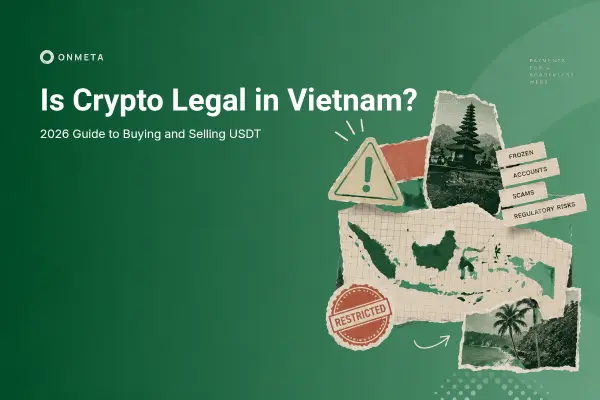
Is Crypto Legal in Vietnam? 2026 Guide to Buying and Selling USDT

Risk & Compliance Head
Overview: Cryptocurrency Laws in Vietnam in 2026
Cryptocurrency can be legally owned and traded in Vietnam, but it is not legal tender and cannot generally be used as an authorised means of payment. Vietnam’s regulatory position became clearer in 2026 after the Law on Digital Technology Industry took effect on January 1, formally establishing definitions and a framework for digital assets.
For users looking to buy crypto in Vietnam, this distinction matters. Holding or trading assets such as Bitcoin and USDT is different from using them to pay for everyday goods and services. Buying or selling USDT with Vietnamese dong (VND) also depends on the platform, payment method, identity verification requirements, and Vietnam’s evolving regulatory framework.
Key Takeaways on Cryptocurrency in Vietnam
Cryptocurrency is recognised within Vietnam’s developing digital asset framework, but it is not legal tender.
Vietnam’s Law on Digital Technology Industry took effect on January 1, 2026 and formally defines categories of digital assets.
Residents can participate in crypto trading subject to the applicable regulatory framework and platform requirements.
Crypto should not be treated as an authorised payment method for ordinary domestic payments in Vietnam.
Anyone buying or selling USDT should consider KYC, anti money laundering controls, exchange rates, fees, and counterparty risk.
Is Crypto Legal in Vietnam in 2026?
Cryptocurrency in Vietnam sits in a more defined legal position in 2026 than it did a few years ago. The Law on Digital Technology Industry now formally recognises digital assets and defines categories including virtual assets and cryptographic assets.
However, recognising crypto as a digital asset does not make Bitcoin, USDT, or another cryptocurrency legal tender. Vietnam continues to distinguish holding and trading digital assets from using crypto as a means of payment. PwC’s analysis of the current framework similarly notes that cryptocurrencies can function as instruments for exchange and investment but are not permitted as a means of payment.
Is Bitcoin Legal in Vietnam?
Bitcoin can be held and traded within Vietnam’s evolving digital asset framework. It is not recognised as Vietnamese currency or legal tender.
That means owning Bitcoin and using Bitcoin to settle an ordinary payment are legally different activities.
Is USDT Legal in Vietnam?
USDT can be bought, held, transferred, and sold subject to applicable regulations and the services available to the user. Stablecoins, however, require some additional care when discussing their legal classification.
The 2026 digital asset law excludes digital forms of fiat money from its definitions of virtual and cryptographic assets, and the treatment of fiat-backed stablecoins continues to develop within Vietnam’s broader regulatory framework.
What Changed in Vietnam's Crypto Laws in 2026?
The major change came from Law No. 71/2025/QH15 on the Digital Technology Industry, which took effect on January 1, 2026. Rather than leaving digital assets without a dedicated statutory definition, the law now expressly addresses them.
Article 47 distinguishes categories including virtual assets and cryptographic assets. Article 48 provides for government management covering areas such as creation, issuance, storage, transfer, ownership, cybersecurity, anti-money laundering, terrorism financing, inspections, and business conditions for cryptographic asset services.
Vietnam has also introduced a pilot framework for its crypto asset market under Resolution No. 05/2025/NQ CP. The framework covers areas such as crypto asset issuance, trading market organisation, service provision, and state management.
So the important 2026 change is not that crypto suddenly became Vietnamese money. It is that the Government of Vietnam has moved digital assets into a more explicit legal and regulatory framework.
For businesses operating across markets, our guide to KYC, AML and Global Crypto Payment Regulations explains how compliance requirements differ across jurisdictions.
Can You Buy USDT in Vietnam?
Yes, users can buy USDT in Vietnam, subject to applicable regulations and the requirements of the platform they use. A typical purchase involves converting Vietnamese dong into USDT through an exchange, P2P marketplace, or supported fiat to crypto service.
A basic flow may look like:
VND → KYC → Payment → USDT → Crypto wallet
Buying USDT With Vietnamese Dong
The available payment methods depend on the provider. Users should check whether the platform supports VND directly, how the fiat payment is processed, and whether USDT is delivered to a custodial account or an external wallet.
KYC is also important. A regulated or compliance focused service may require users to provide identity information before completing fiat to crypto transactions.
Exchange vs P2P
An exchange or structured fiat to crypto service manages more of the transaction flow. With P2P, users transact with another counterparty, usually through a marketplace.
P2P can offer more choice, but it also means users need to pay closer attention to the counterparty, payment account, settlement confirmation, and platform rules.
Businesses building these flows into Web3 products also need to consider the infrastructure behind the transaction. Our guide to how crypto payment gateways work explains the role of payment, settlement, compliance, and integration infrastructure.
How to Sell USDT for VND in Vietnam
Selling USDT reverses the fiat to crypto process:
USDT → Exchange or P2P service → Conversion → VND → Bank or supported payment account
The exact process depends on the platform.
With an exchange or supported off ramp, the service manages the conversion and settlement process. With P2P, the user selects a buyer, receives VND through the agreed payment method, verifies that the payment has actually settled, and then releases the USDT according to the marketplace process.
Users should compare:
USDT to VND exchange rate
Trading or conversion fees
Withdrawal fees
Settlement time
Payment method
Counterparty requirements
When using P2P, users should avoid releasing USDT based solely on a payment screenshot. The VND payment should be independently confirmed through the relevant bank or payment account.
USDT to VND: Understanding Rates and Fees
There is no single permanent USDT to VND rate. USDT is designed to track the US dollar, so its VND value generally reflects the USD to VND exchange rate alongside market pricing, liquidity, platform spreads, and fees.
The amount a user actually receives can therefore differ between exchanges and P2P offers.
A useful way to compare services is:
Effective USDT to VND rate = VND received after applicable fees ÷ USDT sold
Rather than choosing a service based only on the displayed exchange rate, users should check the final amount of Vietnamese dong they will receive after trading, conversion, withdrawal, or other applicable charges.
Is Cryptocurrency Taxable in Vietnam?
Crypto taxation in Vietnam remains an area where users should be careful about making broad assumptions.
Historically, Vietnam lacked dedicated cryptocurrency tax rules because crypto did not have a clear legal classification. The introduction of the new digital asset framework changes the legal backdrop, but it does not mean every tax question involving Bitcoin, USDT, or other digital assets now has a simple universal answer. Earlier PwC analysis specifically noted the absence of dedicated cryptocurrency tax regulations.
Vietnam also introduced wider tax administration reforms in 2026, including new rules focused on digitalisation, electronic identification, system connectivity, and digital business models.
Users trading meaningful amounts should therefore keep records of purchases, sales, fees, transfers, and VND values and obtain current Vietnamese tax advice for their specific circumstances.
Is P2P USDT Trading Safe in Vietnam?
P2P trading can be used safely, but it introduces counterparty risks that do not exist in exactly the same form with a structured fiat to crypto provider.
Users should:
Trade through platforms with escrow protections.
Complete required KYC.
Verify the counterparty's payment details.
Confirm VND has actually arrived before releasing USDT.
Avoid payments from unrelated third party accounts.
Keep communication and settlement within the platform.
A completed bank transfer does not by itself establish the origin or legitimacy of funds. That is one reason KYC, anti money laundering checks, and transaction monitoring matter when evaluating crypto payment infrastructure.
How OnMeta Supports Fiat-to-Crypto Payment Infrastructure
For Web3 businesses, the regulatory question is only one part of operating a fiat to crypto product. Payment rails, identity verification, AML controls, transaction monitoring, settlement, and integration also need to work together.
OnMeta provides crypto payment infrastructure for businesses integrating fiat and digital asset flows across supported markets. Its infrastructure includes on and off ramps, local payment rails, KYC and compliance capabilities, and API based integrations.
For teams evaluating providers, our 2026 crypto on ramp provider guide also covers the major factors businesses should consider when comparing fiat to crypto infrastructure.
Conclusion: Buying and Selling Cryptocurrency in Vietnam in 2026
Cryptocurrency in Vietnam has a clearer legal foundation in 2026, but digital assets should not be confused with legal tender. Bitcoin and USDT can be held and traded subject to the applicable framework, while using crypto as an authorised domestic payment method remains a separate issue.
Anyone buying or selling USDT with Vietnamese dong should consider regulatory requirements, KYC, payment methods, exchange rates, fees, and counterparty risk. For businesses, compliant fiat-to-crypto infrastructure becomes increasingly important as Vietnam formalises its digital asset market.
FAQs: Cryptocurrency and USDT in Vietnam
Can Foreigners Buy Cryptocurrency in Vietnam?
Foreigners may be able to access cryptocurrency services in Vietnam, but eligibility depends on the platform, identity verification requirements, residency rules, and applicable Vietnamese regulations.
Can Tourists Buy USDT in Vietnam?
Potentially, but access depends on whether the provider accepts the tourist's identification, residency status, payment method, and KYC information. A Vietnamese bank account may also be required for some VND based services.
Can I Transfer USDT to a Vietnamese Bank Account?
Not directly. A Vietnamese bank account holds fiat currency such as VND, not USDT. The USDT must first be converted through a supported exchange, off ramp, or other permitted service before VND can be transferred to the bank account.
Does Binance Work in Vietnam?
Binance services may be accessible to users in Vietnam, but availability of individual products and eligibility can change with local regulation and Binance's own regional policies. Users should verify current availability and compliance requirements directly before trading.
Can I Send USDT From Vietnam to Another Country?
Technically, USDT can be transferred between compatible blockchain wallets. However, cross border transfers may be subject to platform rules, anti money laundering controls, reporting requirements, and other Vietnamese or destination country regulations.
Can a Vietnamese Bank Block Crypto Related Transactions?
A bank may restrict, review, or reject transactions when required by its compliance policies, fraud controls, anti money laundering obligations, or applicable regulations. A crypto related transaction does not automatically mean an account will be blocked.
Last Updated: August 2026
Author