Binance P2P vs. Direct On Ramp API: The Real Cost of Friction for Your dApp

Business Head
Overview
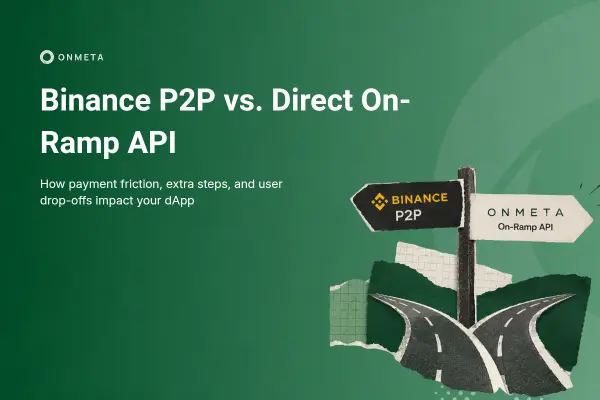
Binance P2P can offer low visible trading costs, but transaction fees alone do not show the complete cost of getting a dApp user from fiat to a funded wallet. Binance states that P2P takers pay zero trading fees, while merchants can set their own prices.
For a dApp, the bigger consideration is the entire user journey. P2P requires users to interact with an external marketplace, while a direct crypto on ramp API can integrate fiat payment, KYC, crypto purchase, and wallet delivery more closely with the product experience.
The real comparison, therefore, is not simply Binance P2P fees vs on ramp fees. It is how efficiently each model turns a new user into a successfully funded user.
Key Takeaways
Binance P2P is a marketplace connecting individual crypto buyers and sellers.
Zero P2P trading fees do not necessarily mean zero total cost for the user or dApp.
Direct on ramp APIs can reduce context switching by integrating fiat to crypto purchasing into the product journey.
dApps should measure cost per successfully funded user, not transaction fees alone.
P2P suits users comfortable with marketplace trading, while on ramp APIs are better suited to products that need greater control over onboarding.
Binance P2P vs. Direct On Ramp API: What's the Difference?
Binance P2P and direct on ramp APIs can both help users move from fiat to crypto, but their operating models are different.
How Binance P2P Works
Binance P2P is a marketplace where users buy and sell crypto directly with other users. Buyers browse available offers, select a seller based on factors such as price and supported payment method, complete payment, and receive crypto through the platform's P2P process.
The journey for a dApp user can look like:
dApp → Binance → P2P marketplace → seller → payment → crypto → wallet → dApp
Binance also requires identity verification before users can trade through its P2P marketplace.
How a Direct On Ramp API Works
A crypto on ramp API allows a dApp to integrate fiat to crypto purchasing into its own product journey.
A typical flow is:
dApp → KYC → fiat payment → crypto purchase → user's wallet
Depending on the provider, the integration can handle payment rails, KYC, transaction creation, crypto delivery, and transaction status updates.
For a deeper comparison of available infrastructure, read Best Crypto On Ramp APIs in 2026.
Is Binance P2P Really Cheaper?
Binance states that P2P takers pay zero trading fees. However, merchants set their own prices, meaning the price offered through the marketplace can include the merchant's margin.
So, zero trading fee does not necessarily mean zero acquisition cost.
Binance P2P Fees and Costs
The final cost of a P2P transaction can depend on the specific offer and transaction journey. Beyond the visible trading fee, users may need to consider seller pricing, payment related costs where applicable, blockchain network costs where applicable, and the steps required to move the crypto to where it is actually needed.
For a dApp, user time and abandonment also matter. A low fee provides little value if the funding journey introduces enough friction that users leave before activating the product.
Visible Fees vs. Cost per Funded User
Cost Factor | Binance P2P | Direct On Ramp API |
Explicit fee | Depends on P2P flow | Provider dependent |
Seller selection | Required | Not required |
Context switching | Usually required | Can be minimized |
User steps | Higher | Can be lower |
Wallet delivery | May require additional steps | Can be integrated |
Developer UX control | Limited | Higher |
An on ramp is not automatically cheaper. The better metric is the total cost required to get a user from the beginning of onboarding to a funded wallet.
The Real Cost of P2P Friction for a dApp
Transaction fees are visible. Friction is harder to measure.
A useful framework is the Friction Tax: the cost created by additional steps, context switching, payment failures, and user abandonment during crypto onboarding.
Where P2P Adds Steps to the User Journey
A user starting inside a dApp may need to leave the product, access Binance, meet its account and KYC requirements, open the P2P marketplace, select an offer, complete payment, receive the crypto, move the required assets where necessary, and then return to the original dApp.
Each additional step creates another point where onboarding can stop.
For the dApp, that can affect:
Checkout abandonment
User activation
Funded wallet conversion
Time to crypto
Customer support requirements
This does not mean P2P is inherently a poor experience. Existing Binance users familiar with P2P may complete the process comfortably. The issue is whether that external journey fits the onboarding experience the dApp wants to provide.
For more on Web3 onboarding drop offs, read 7 Reasons Users Abandon Crypto Wallet Sign Up Flows.
Binance P2P vs. On Ramp API: Side by Side Comparison
Factor | Binance P2P | Direct On Ramp API |
Business model | P2P marketplace | Infrastructure |
User journey | External marketplace | Can be integrated |
Seller selection | Required | Not required |
Payment experience | P2P workflow | Integrated checkout |
KYC | Platform based | Provider based |
Developer control | Lower | Higher |
Branding | External platform | Can fit product UX |
API integration | Not core to P2P journey | Core |
Transaction tracking | Platform controlled | API and webhooks where supported |
Best suited for | Existing P2P users | dApps controlling onboarding |
Which is better for a dApp? Binance P2P can work well for users already comfortable with P2P trading. A direct on ramp API is generally better suited to dApps that want to reduce context switching and integrate fiat to crypto purchasing into their own product.
Before choosing an infrastructure provider, use our Crypto On Ramp Provider Checklist to understand what to evaluate before integration.
What Should dApps Measure Instead of Transaction Fees?
A useful metric is cost per successfully funded user:
Cost per successfully funded user = Total onboarding cost ÷ Successfully funded users
Instead of looking only at payment fees, dApps should track:
KYC completion rate
Payment success rate
Checkout abandonment
Failed transactions
Time to crypto
Funded wallet conversion
Support cost
Average transaction value
The cheapest transaction fee does not necessarily produce the cheapest successful customer acquisition. Measuring the complete journey shows whether users are actually reaching the point where they can use the dApp.
When Should a dApp Use P2P vs. a Direct On Ramp?
The right choice depends on the existing user base and how much of the onboarding journey the dApp wants to control.
Binance P2P Makes Sense When
Users already have Binance accounts.
Users understand P2P trading.
Marketplace choice is important.
The dApp does not need to control fiat to crypto checkout.
A Direct On Ramp API Makes Sense When
Users need to buy crypto within the product journey.
Reducing redirects matters.
Local payment methods are important.
The dApp wants greater control over checkout.
Developers need transaction status and webhook based updates.
For Indian users, local payment methods can be particularly important. For a detailed explanation, read Why UPI Coverage Is Non Negotiable for India On Ramps.
How OnMeta Supports Direct Fiat to Crypto Onboarding
OnMeta provides fiat to crypto and crypto to fiat infrastructure for wallets, exchanges, dApps, and other supported platforms. Its India on ramp supports INR payments through UPI and local bank rails, alongside KYC and compliance infrastructure.
Businesses can integrate through APIs or an embedded widget, with transaction status and webhook support for tracking transaction events.
For a dApp, the value is not simply replacing P2P with another payment method. It is gaining more control over the journey from fiat payment to crypto delivery.
For the technical side, read How Crypto Companies Build Fiat On Ramp and Off Ramp Infrastructure in India.
Conclusion
The real comparison is not Binance P2P fees vs on ramp fees. It is the total cost of getting a user from fiat to a successfully funded wallet.
P2P can work well for experienced users. For dApps that want more control over onboarding, local payments, transaction tracking, and crypto delivery, direct on ramp infrastructure provides a more integrated route.
Explore OnMeta's Crypto On & Off Ramp Infrastructure
Frequently Asked Questions
Is Binance P2P cheaper than a crypto on ramp?
Not necessarily. Binance P2P can have low visible trading fees, but seller pricing and the complete cost of getting a user to a funded wallet should also be considered.
Does Binance P2P have fees?
Binance states that P2P takers pay zero trading fees. Merchants can set their own prices, which may include their margins.
What is a crypto on ramp API?
A crypto on ramp API allows an application to integrate fiat to crypto purchasing, including payment, KYC, transaction creation, and crypto delivery.
Can Users Buy Crypto Directly Inside a dApp?
Yes. A dApp can integrate suitable on ramp infrastructure through an API, SDK, or embedded widget so users can purchase crypto as part of the product journey.
Which Is Better for dApp Onboarding: P2P or an On Ramp?
P2P can suit users already familiar with marketplace trading. A direct on ramp is generally better suited to dApps that want greater control over onboarding and fiat to crypto purchasing.
Last Updated: August 2026
Author